Product Specifications
| Material | Carbon Steel |
Product Introduction
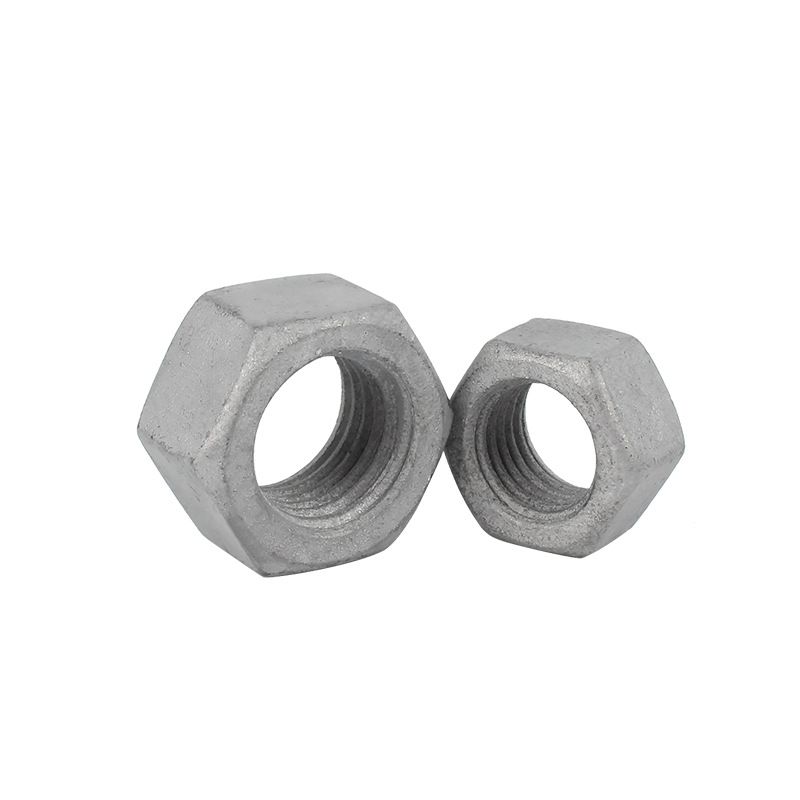
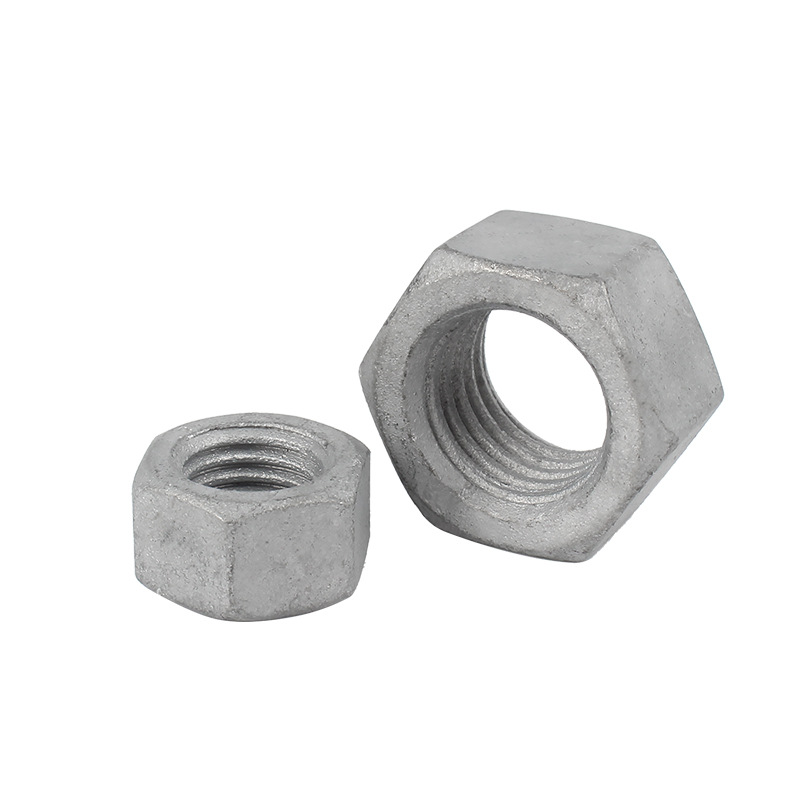
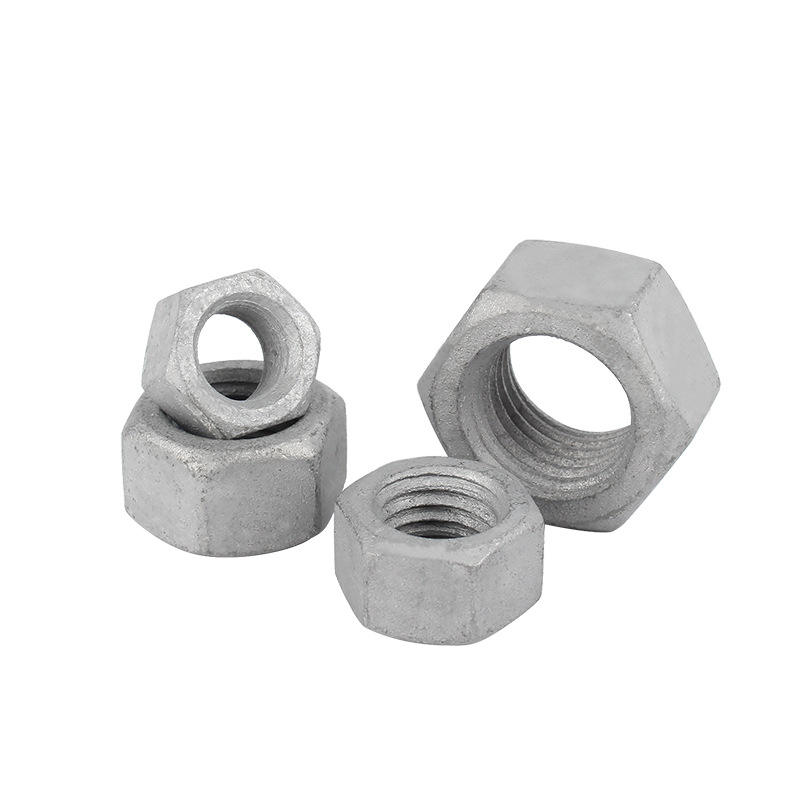
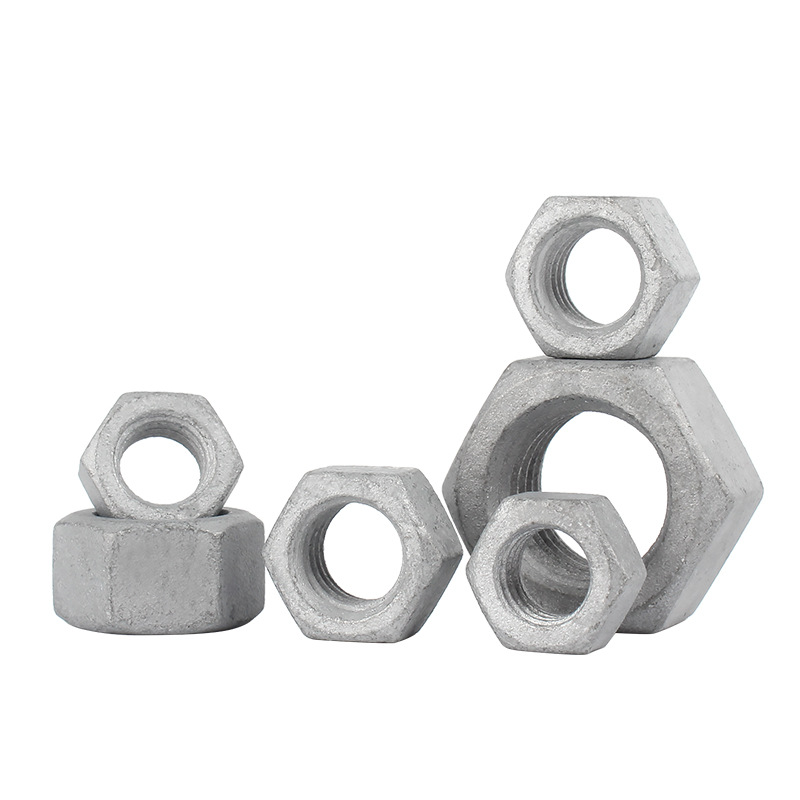
Hot-dip galvanized nuts (also known as hot-dip zinc nuts) are fasteners made by immersing degreased and derusted steel nuts entirely into molten zinc at approximately 450°C, forming a layer of zinc-iron alloy and a pure zinc layer on their surface. The zinc layer thickness is typically between 40–80 μm, much thicker than electro-galvanizing, providing extremely strong anti-corrosion capabilities. Hot-dip galvanized nuts are usually used in conjunction with hot-dip galvanized bolts and flat washers. They are mainly manufactured according to standards such as GB/T 6170 (Style 1 hex nuts) and GB/T 6175 (Style 2 hex nuts). Thread specifications cover M5–M64, and property classes include Grade 4, 6, 8, 10, etc. They are widely used in projects exposed to outdoor environments for long periods, such as power towers, photovoltaic mounting brackets, bridges, and outdoor steel structures.
I. Product Features
-
Heavy-duty anti-corrosion metallurgical bonding: The molten zinc reacts with the steel substrate to form a dense zinc-iron alloy layer with strong adhesion. The corrosion resistance lifespan usually reaches over 20 years, and in industrial atmospheres or coastal environments, it also provides protection for over 10 years.
-
Post-galvanizing tapping process: Because the internal thread dimensions shrink after hot-dip galvanizing due to the thicker zinc layer, standards stipulate that nuts generally adopt a post-galvanizing tapping process (or reserve an oversized tap dimension, such as 6AZ) to ensure smooth fitting with hot-dip galvanized bolts (external threads typically have a 6g tolerance) without damaging the coating.
-
Wide coverage of strength grades: Covers Grade 4, 6, 8, 10, etc. For high-strength nuts of Grade 8 and above, they must be manufactured from alloy steel and subjected to quenching and tempering, and the galvanizing temperature must be controlled to minimize the impact on mechanical properties.
-
Materials and surface quality: Commonly manufactured from carbon steel (such as Q235, 35#, 45#) and alloy steel. The coating surface should be uniform, without missed plating or blistering. Drips and zinc spikes must be controlled within allowable limits.
II. Product Advantages
-
Dual anti-corrosion mechanism: It not only acts as a physical barrier through the thick zinc layer to isolate moisture and oxygen, but when the coating is locally damaged, zinc is more active than iron and will corrode first, playing a sacrificial anode protective role to prevent the nut substrate from rusting.
-
Low life-cycle cost: Compared to stainless steel nuts, hot-dip galvanized nuts have an obvious price advantage in large-scale outdoor projects. Furthermore, they are almost maintenance-free after installation, saving the cost of subsequent anti-corrosion construction and rust-preventive painting.
-
Good anti-loosening performance: The surface of hot-dip galvanized nuts is relatively rough, and the friction coefficient is higher than that of ordinary electroplated nuts, providing better anti-loosening ability after tightening, making them particularly suitable for outdoor structures in vibrating environments.
-
Strong compatibility: As standardized fasteners, they have uniform dimensions and can be perfectly interchanged and matched with various hot-dip galvanized hex bolts and flat washers on the market.
III. Scope of Application
-
Power and communication engineering: Node connections of transmission towers, substation structures, and communication towers are the most core application scenarios.
-
New energy infrastructure: Purlin connections in photovoltaic mounting systems and external fastening of wind turbine towers; exposed outdoors for long periods, they have extremely high anti-corrosion requirements.
-
Transportation and bridge engineering: Highway guardrails, bridge steel structures, railway track auxiliary facilities, and other humid or high salt fog environments.
-
Construction and general steel structures: Industrial plants, steel structure space frames, curtain wall keels, outdoor fences, and other projects requiring maintenance-free anti-corrosion.