Product Specifications
| Material | Aluminum Alloy |
Product Introduction
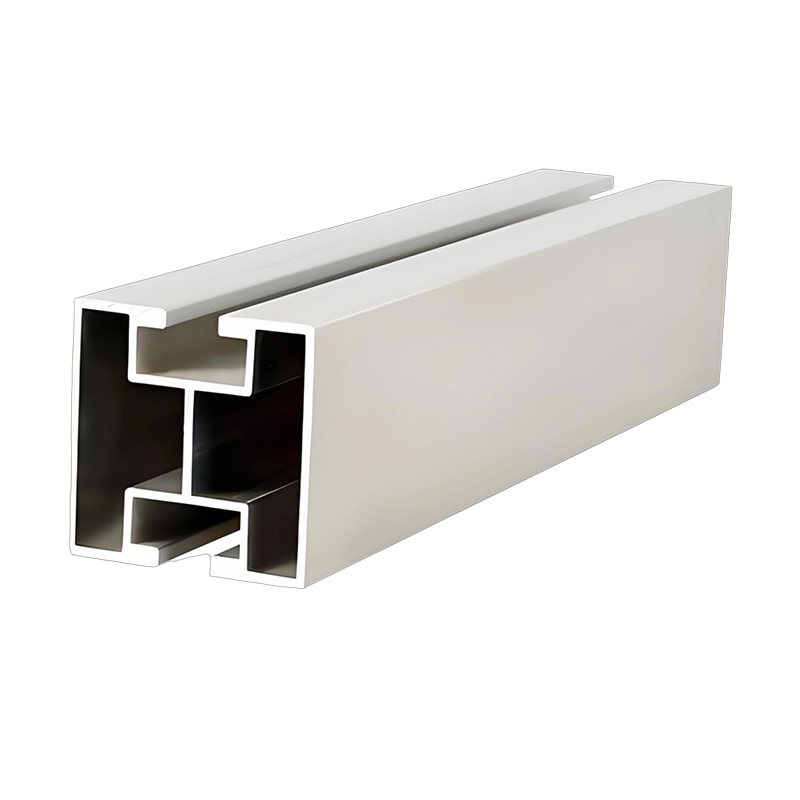
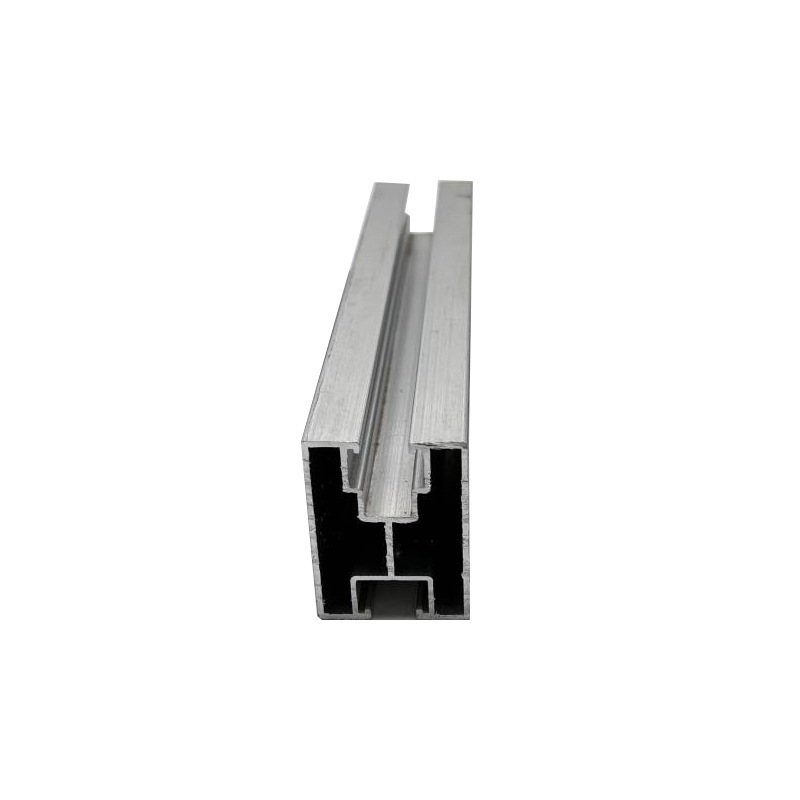
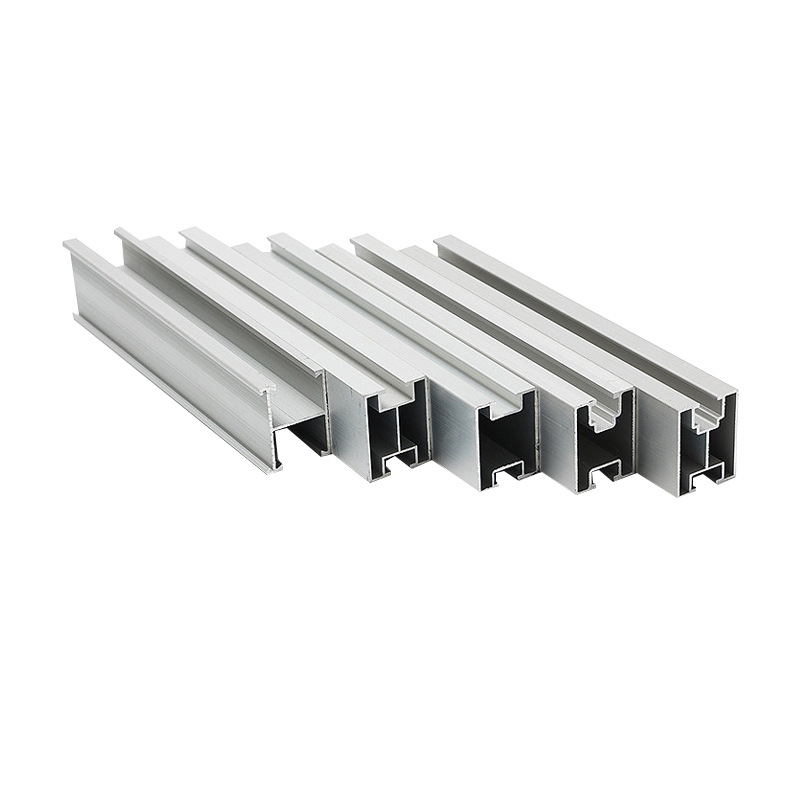
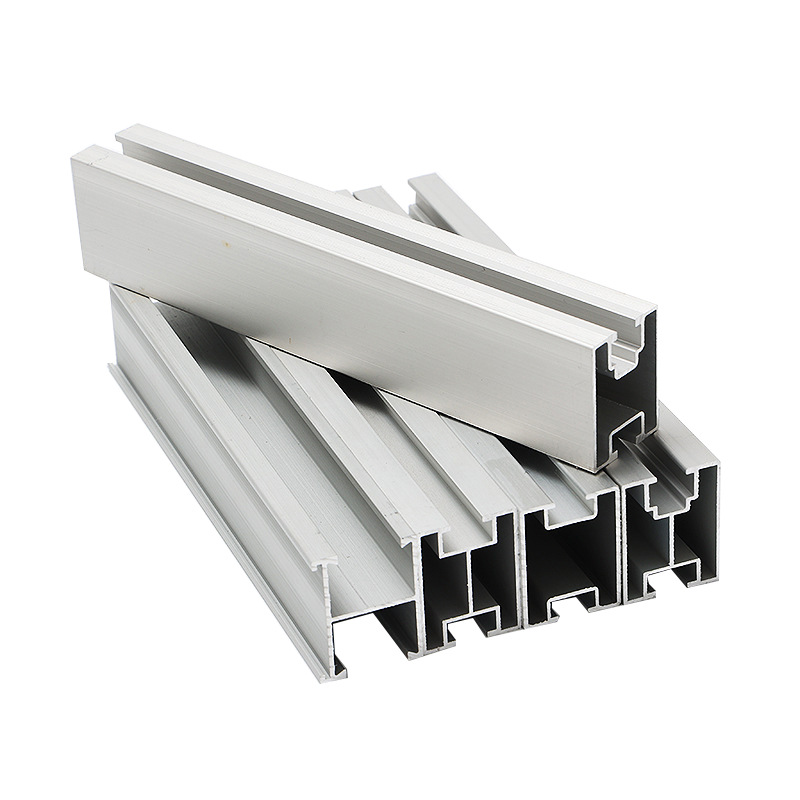
Aluminum alloy guide rails are usually made from AL6063-T5 or AL6005-T5, formed by extrusion and anodized (film thickness commonly 8–12 μm). They are available in a wide range of cross-sections (such as 40×30, 41×32, 40×40, 46×42, etc.), with standard lengths of 3–6 m and customizable options. C-shaped steel guide rails use Q235B or Q355B as the base material, with a common cross-section of 41×41×2.0 mm. The surface is treated with hot-dip galvanizing (zinc coating ≥60 μm) or a zinc-aluminum-magnesium coating, and the zinc coating weight is usually 50–600 g/m². Both product types must meet the load-bearing requirements for wind loads (common design value 40 m/s, up to 60 m/s for high-demand applications) and snow loads (on the order of 1.4 kN/m²). Their design life usually matches the 25-year cycle of a photovoltaic power plant.
⚙️ I. Product Features
Aluminum Alloy Guide Rails
Thin wall thickness and significant lightweight advantage: The density of 6063-T5 aluminum alloy is about 1/3 that of carbon steel. At the same length, it is about 60% lighter than steel guide rails. A single rail can be handled and positioned by one person, making it especially suitable for rooftop distributed projects with strict control over additional roof loads.
Anodized corrosion protection, no dependence on coatings: The surface oxide film is integrated with the aluminum substrate and does not rely on an external coating. There is no problem of accelerated substrate corrosion after coating peeling, and it can meet long-term outdoor use requirements in normal atmospheric environments.
Cross-sections can include reinforcing ribs; thin walls with adjustable bending stiffness: Some products have reinforcing ribs in the middle of the cross-section, increasing load-bearing capacity by about 30% compared with ordinary models while maintaining lightweight properties and resisting wind and snow loads.
Mature compatibility with installation accessories: It forms a standardized matching system with T-bolts, mid/edge clamps, channel nuts, etc. Fastening can be performed by snapping into any position on the rail without on-site drilling or welding.
Hot-Dip Galvanized / Zinc-Aluminum-Magnesium C-Shaped Steel Guide Rails
Larger wall thickness and cross-sectional dimensions, high load-bearing capacity: Q235B/Q355B base material combined with 2.0 mm-class wall thickness and 41×41 mm-class cross-section provides significantly higher bending and shear resistance than thin-wall aluminum rails. It is suitable for long array layouts in large-span, high-snow-load, or ground-mounted power plants.
Hot-dip galvanizing with metallurgical corrosion protection, strong outdoor durability: The zinc layer is metallurgically bonded to the steel substrate. The zinc layer thickness is usually not less than 60 μm. With a zinc-aluminum-magnesium coating, the corrosion resistance life can reach more than 25 years, adapting to industrial atmospheres and general coastal environments.
Hemmed edge with teeth, good anti-slip and shear performance: The hemmed edge structure of C-shaped steel, combined with teeth, can form a mechanical interlock with matching nut blocks, effectively resisting module slippage and shear under wind loads.
Modular punching, on-site welding-free assembly: Installation holes can be pre-punched at the factory, and assembly can be completed on site through bolted connections, reducing damage to the zinc layer caused by welding processes.
✅ II. Product Advantages
Clear load transfer path and guaranteed system stiffness: As the load-transfer intermediary between the modules and the main structure, the guide rail evenly distributes wind, snow, and module self-weight loads to the purlins or roof. Together with clamps and support plates, it can effectively control module deflection and reduce the risk of microcracks.
Lightweight and high load-bearing can be selected according to the scenario: Aluminum alloy guide rails are known for lightweight and weather resistance, suitable for projects sensitive to roof loads; C-shaped steel guide rails are known for high rigidity and high load-bearing capacity, suitable for ground-mounted power plants and large-span arrays. The two form a complementary rather than substitutive relationship.
High construction efficiency and suitability for rapid installation: Aluminum rails can be snapped and locked at any position via T-bolts, and C-shaped steel rails can be pre-punched and modularly assembled. Both significantly reduce on-site drilling, welding, and cutting processes, lowering labor costs and shortening construction periods.
Mature anti-corrosion solutions matching the full life cycle of the power plant: Aluminum alloy anodizing and steel hot-dip galvanizing/zinc-aluminum-magnesium are anti-corrosion systems verified by long-term outdoor use. Under the premise of correct selection, they can cover a 25-year design life and reduce mid-term maintenance and replacement costs.
Standardized accessory ecosystem for convenient procurement and O&M: Mainstream guide rail cross-sections form relatively unified matching dimensions with T-bolts, clamps, channel nuts, etc. Accessories from different suppliers have an interchangeable basis in most scenarios, facilitating spare parts management and later operation and maintenance.
?️ III. Scope of Application
Large ground-mounted photovoltaic power plants: C-shaped steel guide rails, combined with pile foundations or purlin systems, undertake module support and load transfer for long arrays. They are a commonly used solution for ground-mounted projects in high-snow-load and strong-wind areas.
Commercial, industrial, and residential distributed rooftops: Aluminum alloy guide rails are widely used on color steel tile roofs, flat roofs, and sloped roofs due to their light weight, corrosion resistance, and convenient installation. They are especially suitable for renovation projects sensitive to additional roof loads.
BIPV (building-integrated photovoltaics) systems: Aluminum alloy guide rails can be integrated with waterproof rails and clamp systems, combining module fixation with roof waterproofing node design.
Complex roof forms: For different roofs such as color steel tiles (angle-lock, standing seam, trapezoidal), ceramic tiles, and asphalt shingles, non-destructive installation can be achieved through matching clamps and guide rail combinations.
Mobile and adjustable mounting systems: The lightweight characteristics of aluminum alloy guide rails give them an operational advantage in scenarios requiring frequent disassembly and assembly or angle adjustment.