Wohe Research · Article revision V1
Digital twins for bolted joints: what is needed between tightening data and process assessment?
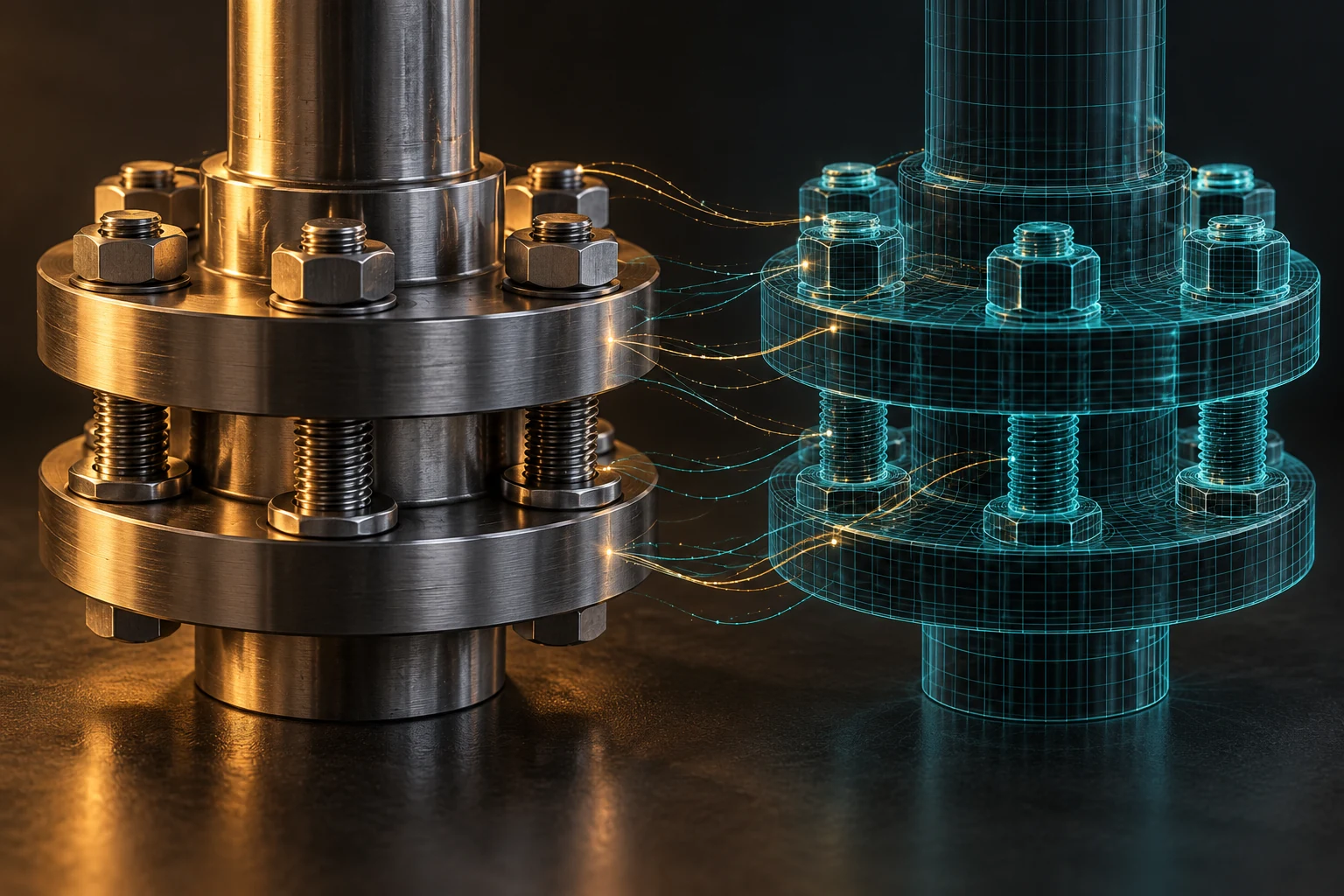
At a glance
Drawing on a 2026 paper on robotic fastening systems, Wohe Research discusses the data foundation, model validation and abnormal-result review needed for digital twins, and proposes studying assembly-process drift.
Research question
How can tightening data support assembly-process assessment after independent validation?
Guidance & practice
Research observation / proposed research topic
This article interprets publicly available literature as of 2026-10-16. Wohe's research proposals are suggested directions; they do not represent approved projects, completed tests or developed products.
The ability of tightening equipment to record data does not establish that a digital twin exists. A useful digital model must also correspond to a real object, with validation explaining which questions it can help assess.
Hebei Wohe Fastener Manufacturing Co., Ltd. follows digital technology applications in bolted joints, focusing on the links among data, models and on-site decisions.
How is recent research using digital twins?
A study published in 2026 applied digital twins to robotic fastening systems, seeking to connect requirements, design, process monitoring and maintenance in a unified framework. Its reported improvements came from simulation research and cannot be treated as benefits already achievable on other production lines. Research source: digital-twin integration for robotic fastening systems in industrial automation
For manufacturers, the study invites discussion of how models can support specific assessments.
What is needed after tightening curves have been collected?
In Wohe's view, a first step worth discussing is identifying the product, assembly location and operating conditions associated with the data.
| Information | Role in the research |
|---|---|
| Product and batch identity | Distinguish specimen sources |
| Joint structure and assembly location | Define the object represented by the model |
| Bolt, nut and contact-surface conditions | Record variables affecting assembly |
| Tool and program versions | Explain changes in operating conditions |
| Torque, angle and other process data | Describe the tightening process |
| Independent validation results | Assess whether model outputs are trustworthy |
With curves alone and no condition information, a model may struggle to explain differences between batches.
A question worth studying: can process drift be detected early?
Wohe's proposed topic is to investigate, for one fixed joint configuration, whether changes in tightening data can provide clues for process reassessment.
For example, controlled tests could separately change tool condition, surface condition or component fit, observe how process data change, and use independent inspection to confirm the causes.
Such research should evaluate:
- Whether normal variation can be distinguished from abnormal changes.
- Whether different causes produce similar signals.
- Whether the model remains effective on new batches.
- Which reassessment measures should follow an alarm.
Model outputs should first be validated as decision support; they cannot directly replace prescribed quality inspections.
How can a data model avoid merely “looking accurate”?
The research plan needs to separate model-development data from validation data. Where data from the same product and test are highly similar, the validation approach must also be examined to establish whether it adequately tests generalization.
Evaluation should consider not only overall accuracy but also false alarms, missed detections, detection delay and applicable scope. Model updates require retained versions and validation evidence.
These are research-design requirements proposed by Wohe, not a statement that such a system has been deployed.
Looking ahead: can product records and assembly feedback improve manufacturing together?
One possible direction links manufacturing batches to assembly feedback to identify questions requiring further investigation.
For example, if assembly curves for a batch change persistently, buyer and supplier could jointly review the product, surface condition and tool conditions before deciding whether dedicated testing is needed.
The value of digital twins must be demonstrated through specific questions and independent validation. Connecting product identity, data conditions and quality evidence is a foundational research topic worth discussing in the fastener industry.
Methods, conditions and evidence
Public literature interpretation and engineering-question analysis are used to propose future validation directions. No Wohe in-house tests have been conducted or reported. The cited findings apply to the conditions of the original papers and cannot be directly extrapolated into product conclusions.
Findings
This page presents research observations and proposed topics. It does not mean that Wohe has approved a project, completed tests, deployed a system or developed a product. Actual engineering applicability still requires independent validation.
Scope and limitations
This article does not establish joint safety, product certification or suitability for a particular application. The research proposals do not mean that projects have been approved or validation completed. Findings from individual publications must not be used directly to set on-site torque, lubrication, reuse counts or disposition of critical joints. Actual applications should be assessed by appropriate technical personnel against the design, applicable specifications and confirmed inspection conditions.
Evidence and sources
Based on research-observation manuscripts supplied by the website owner, with all original literature links retained in the body. The manuscripts state a literature-search cutoff of 2026-10-16. For this publication, relevant publication details and publicly accessible abstracts or indexed excerpts were editorially checked; this was not a full-text review of every paper, and no Wohe on-site tests were conducted. The cited research findings belong to the original paper authors; the future proposals in this article are suggested directions.
Source document ↗https://www.mdpi.com/2079-8954/14/4/372Check the issuing organization for the full document and its latest status.
Article revision V1
First publication of research observations and proposed topics based on manuscripts supplied by the owner, using AI-assisted translation and conceptual illustrations.
You are reading the published revision. Later drafts are reviewed before they replace this page.